

How Does a Heat Pump Water Heater Work?
A heat pump water heater works by running a refrigerant cycle: a fan pulls warm air across an evaporator coil, the refrigerant absorbs that heat, a compressor concentrates it, and the heat transfers into the water in the tank. The water heater does not create heat; it relocates heat that already exists in the room.
That cycle produces a useful byproduct. As the heat pump strips warmth and moisture from the air, the water heater blows cool, dry air back into the space around it, so the unit lightly cools and dehumidifies wherever it sits.
Efficiency for any water heater is measured by the Uniform Energy Factor (UEF): the amount of hot water energy delivered for each unit of electricity consumed, a ratio engineers also express as a coefficient of performance (COP). Heat pump water heaters that qualify for Florida utility rebates carry a UEF of 3.3 or higher, and that high UEF is what drives the monthly savings covered later in this guide.
Why Florida Garages Are Perfect for Heat Pumps
Florida garages are perfect for heat pump water heaters because the warm, humid garage air feeds the heat pump year round, keeping the water heater near peak efficiency in every season. A St. Petersburg garage rarely goes cold, so the unit never runs short of the warm air it uses as fuel.
The dehumidifying byproduct works in your favor here too. A heat pump water heater in a Pinellas County garage pulls moisture out of the air every time it runs, which means drier storage, less musty air, and less condensation on tools and boxes, a small dehumidifier you never have to empty.
Contrast that with northern installations. In a cold basement up north, a heat pump water heater fights chilly winter air and leans on its backup elements, which shrinks the savings. Tampa Bay homes never face that penalty. We install these water heaters in garages, utility rooms, closets, and attics across St. Petersburg, and the garage is the placement we recommend most.
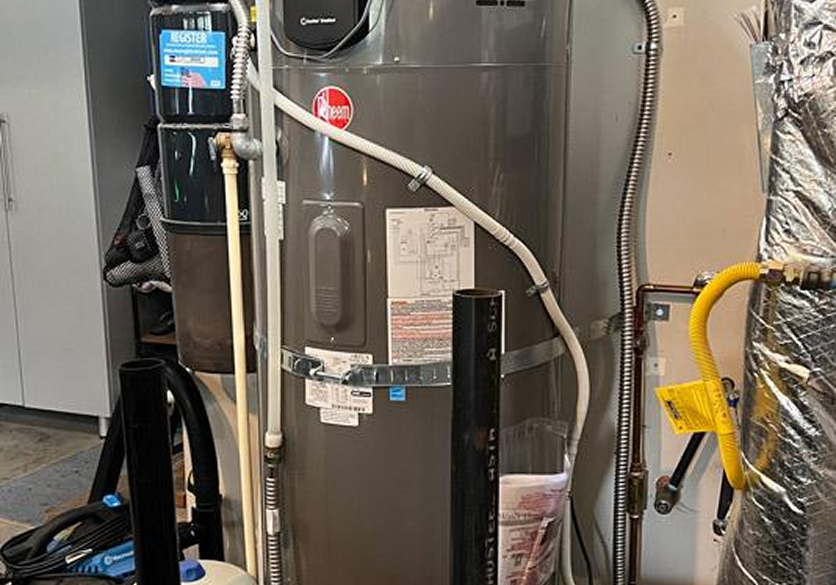
What Do They Cost, and What Do They Save?
Online pricing guides and market research show that heat pump water heater costs can vary considerably depending on the unit, installation requirements, electrical work, and other site-specific conditions. Published estimates commonly place installed heat pump water heaters between about $2,000 and $8,000, with many installations falling within a narrower range. Standard electric tank water heater pricing can also vary. These figures are general estimates rather than guaranteed pricing for St. Petersburg homes, and your actual cost will depend on the specific installation. The unit itself can represent a significant portion of the total heat pump water heater cost. The table below compares the two options using general published estimates.
| System | Installed cost | Estimated monthly energy cost |
|---|---|---|
| Standard electric tank water heater | $1,200–$2,500 (around $1,850 for a standard replacement) | Baseline; costs a family of four about $550 more per year than a heat pump unit, per ENERGY STAR |
| Heat pump (hybrid) water heater | $2,000–$8,000; most jobs $3,200–$4,700 | Uses 70 percent less energy than a standard electric tank; roughly $550 per year saved for a family of four, per ENERGY STAR |
This table shows the installed price gap between a standard electric water heater and a heat pump water heater alongside what each costs to run per month. Payback on the higher installed price depends on how much hot water your household uses: a larger family that showers, washes, and runs the dishwasher daily recovers the difference faster than a one-person home with light usage. Want to see how every water heater type prices out by size and fuel? Water Heater Replacement Cost in St. Petersburg, FL breaks down installed prices across the full lineup.
Online price ranges can only tell you so much. To save yourself the frustration of guessing what your project may cost, try our free water heater cost calculator for a more accurate price range based on your specific needs.
Which Rebates and Tax Credits Apply?
One rebate applies to a heat pump water heater installed in St. Petersburg in 2026: Duke Energy Florida's rebate of up to $800; the federal 25C tax credit expired and no longer applies. Congress terminated the 25C credit, December 31, 2025 was the last eligible installation date, and a water heater installed in 2026 does not qualify, even though older pages still advertise the expired 30 percent credit with its $2,000 cap. Which incentives remain worth claiming this year? Water Heater Rebates & Tax Credits in Florida (2026) tracks the current list.
The Duke Energy Florida rebate is active and worth real money on a heat pump water heater: $500 on a qualifying 50 gallon unit and $800 on a qualifying 80 gallon unit. The water heater must be ENERGY STAR certified with a UEF of 3.3 or higher, and Duke requires a free Home Energy Check before the rebate is paid. TECO offers no residential water heater rebate; its water heating program covers business customers only. When we quote your heat pump installation, we tell you whether the tank size you are considering qualifies for the $500 or the $800 tier, so the rebate is part of the math from the start.
What Are the Disadvantages of a Heat Pump Water Heater?
A heat pump water heater has five disadvantages: higher upfront cost, a running compressor hum, space and clearance requirements, slower recovery after heavy use, and the cool air it releases into the room. These are the same points we walk every customer through before installation, because a heat pump water heater is the wrong choice in the wrong spot.

Higher upfront cost. A heat pump water heater costs $3,200 to $4,700 installed on most jobs, well above the roughly $1,850 standard electric tank replacement, and the Duke rebate narrows that gap without closing it.

Compressor hum. A heat pump water heater runs a steady compressor hum while heating, rated around 49 decibels on popular models, about the sound of a box fan, though some units run louder in practice, where a standard electric tank is nearly silent. A steady hum is normal operation; hissing or popping is not, and usually points to sediment heating at the bottom of the tank.

Space and clearance. A heat pump water heater needs ceiling height and open air around it to breathe; sealed in a tight closet, the water heater starves itself of the warm air it feeds on.

Slower recovery. After heavy back-to-back use, a heat pump water heater reheats more slowly in heat-pump-only mode than a standard electric tank; hybrid mode engages the backup elements when demand spikes.

Cool exhaust air. A heat pump water heater cools the space it sits in, a real drawback beside a bedroom up north and a genuine feature in a St. Petersburg garage.
Why do some contractors steer homeowners away from heat pumps? Usually unfamiliarity: a plumber who rarely installs hybrid water heaters worries about callbacks on equipment he does not know, not about the technology itself.
Heat Pump vs. Conventional Electric vs. Tankless
The heat pump water heater wins on monthly operating cost among electric options, the tankless water heater wins on endless hot water, and the conventional electric tank wins on upfront price. Here is how the three verdicts break down for a St. Petersburg home.
The heat pump water heater delivers the lowest monthly energy cost of any electric water heater, because moving heat takes far less electricity than generating it. If your home runs on electric water heating, as most Florida homes do, the hybrid is the efficiency ceiling; only a gas tankless unit competes on operating cost, and that assumes a gas line you may not have.
The tankless water heater delivers hot water without a storage limit, so a high-demand household never drains a tank. It heats water only on demand, but it does not match the heat pump's efficiency on electric fuel, and electric tankless models demand heavy dedicated circuits. Weighing the storage formats themselves? You can compare tank and tankless water heaters point by point before choosing a direction.
The conventional electric tank water heater remains the lowest upfront cost of the three and the simplest swap. It gives up the monthly savings, which is why we frame it as the right choice for tight budgets and short time horizons rather than the best long-term value.
How Does Installation Work?
A heat pump water heater installation typically takes several hours, although the exact time depends on the size of the unit, the existing setup, and whether additional plumbing or electrical work is required. For a home with an existing electric tank, installation may be relatively straightforward if the current 240V circuit meets the new unit’s requirements. If a new or upgraded dedicated circuit is needed, that electrical work is completed separately by a qualified electrician, and the cost depends on the existing panel, wiring distance, and scope of the electrical work.

Remove the old water heater.
We drain, disconnect, and haul away the old unit. Removal and disposal are handled as part of the installation process, while any permit requirements depend on the specific project.

Set and connect the new heat pump water heater.
The tank connects to the existing water lines and, when compatible, the existing electrical connection. If electrical upgrades are required, they must be completed by a qualified electrician.

Run the condensate line.
Every heat pump water heater produces condensate that must drain to an appropriate location. If gravity drainage is not practical, a condensate pump may be required. The additional cost varies depending on the pump, drain routing, and installation conditions.

Test and inspect the finished water heater.
Once installation is complete, the system is tested, the operating mode is set, and applicable installation requirements are checked before the job is finished.
Attic installations carry extra code requirements in Florida, and we build them into the quote: the attic needs a minimum 24 by 30 inch opening, a maintenance pathway at least 24 inches wide, a 30 by 30 inch platform at the water heater, and a secondary drain pan under the unit. The owner performs our heat pump installations personally, so the plumber who quotes your water heater is the one standing in your garage.

Is a Heat Pump Water Heater Right for You?
A heat pump water heater is right for you when you have a garage or utility room to put it in, your home already heats water with electricity, and you plan to own the home for five or more years. A heat pump water heater lasts 10 to 15 years, and some units reach 20 with maintenance, so a five-year horizon gives the monthly savings time to repay the installed price. Skip the heat pump water heater when recovery speed after heavy use is critical for your household, or when the only available spot is a sealed closet without the clearance the unit needs to breathe.
Rheem, A.O. Smith, and Bradford White make the best heat pump water heaters, and we install hybrids from all of them with a primary focus on A.O. Smith and State, the two brands we hold factory certifications for. Water Heater Brands We Install & Service covers the full lineup we work on.