

A leaking water heater is a plumbing failure in which water escapes the tank, its fittings, or its valves, and the right response comes down to two questions: where the water is coming from and how fast it is coming. A slow drip at a hot water heater’s drain valve is a minor repair, while a spreading puddle under the tank is an emergency, because a visible tank leak puts floors, drywall, and nearby belongings at immediate water damage risk. One safety line first: tank water runs at 120°F or hotter, so treat any water leaving a water heater as scalding until the unit is off. This guide opens with the four steps to take right now, then weighs how dangerous a leaking water heater really is, from water damage and scalding to the rare explosion scenario tied to the relief valve, and answers whether you can still use water while the leak waits for service. It then reads the leak by location: from the bottom, from the top, from the T&P relief valve: T&P stands for temperature and pressure relief valve. It is typically factory-set to open at 210°F or 150 psi to help prevent unsafe temperature or pressure buildup inside the water heater., and from the drain valve, with a benign-or-serious verdict and a fix path for each. It closes with how long a leaking water heater will last, the repair-or-replace call, getting the leak fixed today with same-day emergency service in St. Petersburg, and quick answers on leaks from underneath and on draining the tank.
What to Do Right Now (4 Steps)
When a water heater is leaking, do four things in this order: cut the power, shut the water, protect the floor, and call for same-day service.
- Turn off the power. Switch the water heater’s circuit breaker off for an electric unit, or turn the gas control dial to OFF on a gas unit.
- Shut the cold-water supply. Close the shutoff valve on the cold inlet pipe above the water heater, turning a round handle clockwise or a lever a quarter turn.
- Protect the area. Move belongings away from the leaking water heater and lay towels or set a shallow pan to catch the water.
- Call for same-day service. Call (727) 855-8080, describe the leak, and we dispatch same-day emergency service for leaking water heaters across St. Petersburg.
Cannot find the shutoff, or the valve will not budge? We walk callers through the power and water shutoff steps over the phone at no charge, before any truck rolls, because a water heater isolated in the first five minutes does a fraction of the damage of one left running. With the unit off and the supply closed, the next question is how much danger the leak carried.

Is a Leaking Water Heater Dangerous?
A leaking water heater is dangerous primarily as a water damage and scalding hazard, and both risks are immediate; explosion is rare and tied to a failed temperature and pressure relief valve. Water damage starts the moment a leak reaches the floor: a tank holds 30 to 80 gallons, and a water heater that fails in a garage, closet, or attic can release all of it. Scalding is the second immediate risk, because water escaping a leaking water heater leaves the tank at full storage temperature, 120°F or hotter. Explosion sits in a different category: a tank can only overpressurize when its T&P relief valve is blocked or has failed, so a working relief valve removes the explosion scenario from an ordinary leak. How do explosion, carbon monoxide, and scalding hazards develop around a water heater, and what stops each one? Water Heater Safety: Explosions, CO & Scalding Risks Explained covers the full risk list.
Can You Still Use Water While It Leaks?
You can usually still shower briefly with a minor fitting leak on a water heater; stop using the heater entirely the moment water pools at the base of the tank. A small drip at a pipe fitting, with the tank itself dry, leaves the water heater serviceable, so running hot water while you wait for a same-day repair is generally fine. A puddle at the base means the tank body is leaking, and continuing to heat and refill a failing tank pushes more hot water toward the breach, so shut the water heater down for good. Cold water is unaffected: closing the valve on the water heater’s cold inlet stops the leak’s supply while every cold tap in the house keeps working. Do you have to shut the whole unit off for a single drip? Not always, but power and water off is the safe default when you are unsure which leak you have.
Leaking From the Bottom
A water heater leaking from the bottom traces to four sources, ordered by how often we find them: a loose or failed drain valve, discharge from the T&P valve’s drain tube, condensation, and a breach in the tank wall itself.
- Drain valve: the spout near the floor of the water heater loosens or wears, producing the most common and most benign bottom leak.
- T&P discharge tube: the relief valve’s pipe ends near the floor, so relief valve discharge often reads as a bottom leak even though the water heater’s valve sits up top.
- Condensation: a tank refilling with cold water can sweat in humid Florida air, leaving harmless moisture under a water heater that is not leaking at all.
- Tank-wall breach: water seeping from under the jacket with every fitting dry means internal corrosion has opened the water heater’s tank body.
The verdict splits cleanly. The first three sources are repairs or non-events, and the fix path runs from tightening or replacing the drain valve to correcting whatever makes the relief valve discharge. A tank-wall breach is the serious one: a tank-body leak means replacement at any age, whether the water heater is 4 years old or 14, because the corrosion that opened the wall cannot be welded or sealed from outside.
Leaking From the Top
A water heater leaking from the top leaks at one of three points: the cold inlet or hot outlet fittings, the T&P relief valve’s mounting threads, or the anode rod port, and all three are repairable. Top leaks are the good news category: every one involves a connection rather than the tank body. The fix path is straightforward: corroded or loose inlet and outlet fittings get tightened, resealed, or repiped; a valve weeping at its threads gets rethreaded or replaced; a seeping anode port gets a new gasket when the rod is reseated. Leak repairs at water heater fittings and valves run $50 to $600, with most homeowners paying $150 to $500 depending on the part and the pipe work involved. One caution: gravity moves water, and a top leak can run down inside the water heater’s jacket and drip out at the base, mimicking a bottom leak, so check the top fittings with a dry paper towel before concluding the tank has failed.
Leaking From the T&P Relief Valve
A T&P relief valve that leaks is doing one of three things: discharging normally to relieve pressure from thermal expansion, failing from age or sediment, or venting genuine overpressure. A small discharge that appears after heating cycles, in a home with a closed plumbing system, is usually thermal expansion: heated water expands, pressure spikes, and the valve does its job. An expansion tank absorbs that pressure swing, and a relief valve that drips after every recovery cycle is often a sign the home needs one installed or recharged. A valve that drips constantly, regardless of heating, has typically failed from age or trapped sediment; replacing a T&P valve runs $100 to $300, about $200 for most water heaters. Steady hot discharge or repeated forceful blowoffs mean real overpressure or overtemperature, and that water heater should be shut down immediately. Never cap or plug a discharging relief valve, because the valve is the tank’s last safety device. Not sure whether the valve on your water heater is working or failing? T&P Relief Valve: Function, Testing & Leaks explains how the valve operates and how to test it in place.
Leaking From the Drain Valve
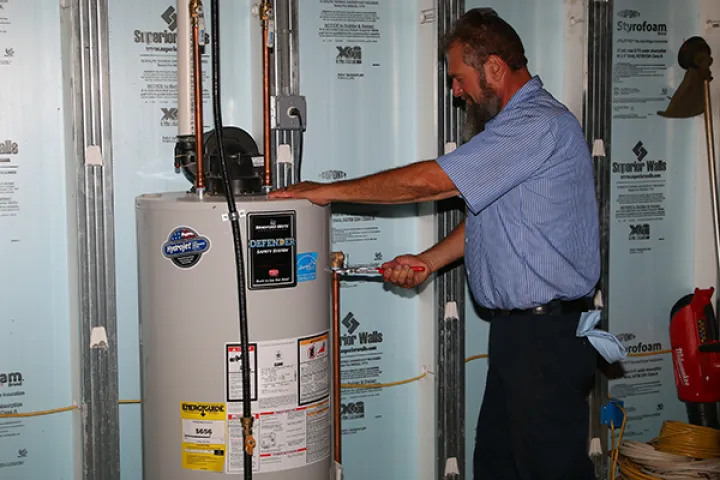
A leaking drain valve is the cheapest water heater leak to fix, and the fixes run from tightening the valve to replacing the washer, capping the outlet, or swapping the valve entirely. Start by snugging the valve gently clockwise; over-tightening cracks plastic valves. If the drip continues, a worn internal washer can be replaced, and a garden hose cap threaded onto the outlet works as a reliable stopgap on a water heater until the valve is serviced. The drain valve is one of the least expensive parts on a water heater, and a full valve swap sits at the low end of the leak repair range. One pattern from St. Petersburg service calls: some drain valves leak because sediment has jammed them partly open, and we have opened valves that give only a trickle because the tank bottom is packed solid with scale. A water heater that can no longer be drained is closer to the end of its service life than its drain valve is.
How Long Will a Leaking Water Heater Last?
How long a leaking water heater lasts depends entirely on the source: a fitting or valve leak leaves the water heater serviceable while it waits for repair, but a tank-body leak worsens on a scale of days to weeks and never improves. A drip at a drain valve or inlet fitting is stable, because the connection is failing rather than the vessel, and the water heater keeps producing hot water safely in the meantime. A tank leak follows the opposite curve: the corrosion that opened the wall keeps working, the weep becomes a stream, and the stream can become a sudden release, which is why a leaking tank gets replaced now rather than watched. Age frames the decision. Tank water heaters last 8 to 12 years, and most tank-body leaks arrive near the end of that range, but the replacement verdict on a leaking tank holds at any age. Weighing a $150 to $500 fitting repair against the age of the unit under it? Our repair-or-replace decision guide runs that math for every failure type, leaks included.
Get the Leak Fixed Today
You know where the water heater is leaking and what the leak means, so what does getting it fixed today look like? Florida Water Heater Pros dispatches same-day emergency service for leaking water heaters across St. Petersburg and Pinellas County, with a free phone diagnosis before any visit. Call (727) 855-8080, tell us where the water is coming from, and we will tell you over the phone whether you are looking at a fitting repair or a tank replacement, with upfront pricing. Fitting and valve leaks are typically repaired in a single visit. When the tank body has failed, stock is what turns an emergency into an afternoon: we stock 30, 40, and 50 gallon water heaters in multiple variants, so a tank leaking in the morning is usually replaced the same day, with a standard installation taking about 3 hours on site. Every hour a leak runs adds water damage, and stopping that damage is the point of same-day dispatch. Our emergency water heater repair in St. Petersburg covers every leak on this page, from a weeping drain valve to a failed tank.
Call (727) 855-8080 for your free phone diagnosis.
