
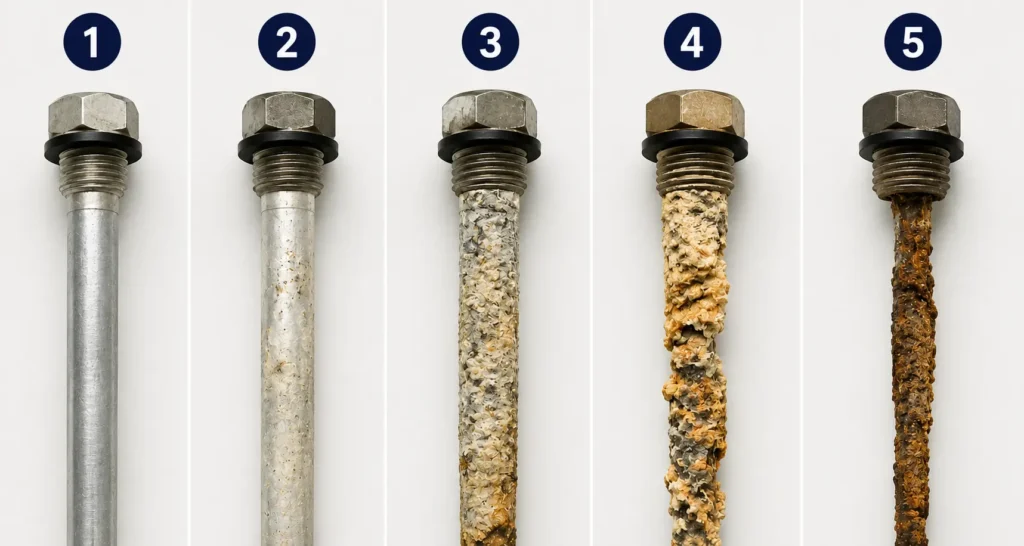
Water Heater Anode Rods: What They Are & When to Replace
A water heater anode rod is a corrosion-protection component that helps prevent the steel tank from rusting internally. Often called a sacrificial anode rod, it gradually corrodes instead of the exposed steel surfaces inside the water heater. When the rod becomes significantly depleted, the tank may lose some of its protection against corrosion.
Most conventional steel storage tank water heaters use an anode rod, but the type, location, and replacement requirements vary by manufacturer and model.
For homeowners in St. Petersburg, Clearwater, and throughout Pinellas County, anode rod maintenance is worth understanding because water chemistry can affect how quickly these components deteriorate. Dissolved minerals, conductivity, treatment methods, and other water conditions influence corrosion behavior.
Florida’s water quality varies by location and source. Some homes use treated municipal water, while others rely on private wells. These differences can affect water heater maintenance needs, including anode rod inspection and replacement.
Anode rods are designed to deteriorate as they protect the tank. However, they do not last indefinitely, and a depleted rod may leave the water heater more vulnerable to corrosion.
This guide explains what anode rods do, how they work, the differences between magnesium, aluminum, and powered anodes, when to inspect them, and what homeowners should know before attempting replacement.
Florida Water Heater Pros provides water heater inspections, maintenance, and repairs throughout Pinellas County, Florida.
Concerned about your water heater’s anode rod? Call Florida Water Heater Pros at 714-686-1649 to request a professional inspection or free phone estimate.
What Is a Water Heater Anode Rod?
A water heater anode rod is a metal component designed to reduce corrosion inside a steel storage tank.
Most conventional tank water heaters use a protective glass or porcelain-based lining to separate stored water from the steel tank.
However, small imperfections or exposed areas may exist in the lining.
When water contacts exposed steel, corrosion can develop.
The anode rod provides additional protection by using a metal that corrodes more readily than the steel tank.
This process is known as sacrificial corrosion protection.
Where Is the Anode Rod Located?
In many storage tank water heaters, the anode rod is installed through an opening near the top of the tank.
Some models use a dedicated anode rod connection, while others incorporate the anode into a hot-water outlet assembly.
The location varies by manufacturer and model.
Certain water heaters may have multiple anodes or use different corrosion-protection designs.
Homeowners should consult the manufacturer’s documentation before attempting to locate or remove the component.
Do All Water Heaters Have Anode Rods?
No. Anode rods are commonly found in conventional glass-lined steel storage tank water heaters.
However, not every water heater uses the same corrosion-protection system.
Some stainless steel tanks, tankless water heaters, and other specialized designs may not require a conventional sacrificial anode rod.
Heat pump water heaters with steel storage tanks may also contain anode rods, depending on the manufacturer.
Always verify the equipment design before purchasing replacement parts.
How Does a Water Heater Anode Rod Work?
A sacrificial anode rod protects a steel water heater tank through an electrochemical process.
When the anode and exposed steel are in contact with water, the more reactive anode material preferentially corrodes.
This helps reduce corrosion of the exposed steel tank surfaces.
Over time, the anode material is gradually consumed.
The rate of deterioration depends on water chemistry, tank conditions, and the anode material.
Why Is It Called a Sacrificial Anode Rod?
The term sacrificial describes the component’s intended function.
The anode rod gradually deteriorates to help protect the tank.
As the rod corrodes, it may become thinner, develop irregular surfaces, or lose sections of its original material.
Eventually, the remaining anode may no longer provide adequate corrosion protection.
This is why periodic inspection matters.
What Happens When an Anode Rod Stops Working?
When a sacrificial anode becomes significantly depleted, exposed steel surfaces inside the tank may become more vulnerable to corrosion.
The protective tank lining still provides some protection, but damaged or exposed areas may deteriorate over time.
Potential consequences include internal rust formation, discolored hot water, and eventual tank leakage.
A depleted anode does not mean the water heater will immediately fail.
However, replacing a worn rod before substantial tank corrosion develops may help preserve the equipment’s corrosion protection.
What Are the Different Types of Water Heater Anode Rods?
Several types of anode rods are used in residential water heaters.
The appropriate choice depends on the water heater manufacturer, water chemistry, and equipment design.
Magnesium Anode Rods
Magnesium is commonly used in sacrificial anode rods.
It is relatively reactive and can provide effective corrosion protection in suitable water conditions.
However, magnesium anodes may deteriorate more quickly in certain water chemistries.
In some systems, reactions involving magnesium anodes may also contribute to hydrogen sulfide odors when sulfate-reducing bacteria and other suitable conditions are present.
Best use: Water heaters where the manufacturer specifies or approves magnesium anodes.
Aluminum Anode Rods
Aluminum-based anode rods are another common option.
They generally have different electrochemical properties and consumption characteristics than magnesium rods.
Their performance depends on water chemistry and tank design.
Some replacement anodes use aluminum alloys rather than pure aluminum.
Best use: Systems where the manufacturer specifies or approves the particular aluminum-based anode.
Aluminum-Zinc Anode Rods
Some anode rods use aluminum-zinc alloys.
These products are sometimes considered when homeowners experience sulfur-related hot water odors.
However, replacing an anode rod does not guarantee that a rotten egg smell will disappear.
The odor may originate from the water supply, microorganisms, plumbing, or other conditions.
Best use: Applications where the specific alloy is compatible with the water heater and recommended for the identified water conditions.
Powered Anode Rods
Powered anode systems use an electrical control to provide corrosion protection rather than relying on a conventional sacrificial rod that gradually dissolves.
These systems are sometimes called impressed-current anodes.
Their compatibility depends on the water heater design and manufacturer requirements.
A powered anode should not be installed unless it is approved for the specific equipment.
Best use: Compatible water heaters where a manufacturer-approved powered anode system is appropriate.
Magnesium vs. Aluminum Anode Rod: Which Is Better?
Neither material is automatically the best choice for every water heater.
Magnesium and aluminum-based anodes have different characteristics, and their performance depends on water chemistry.
| Feature | Magnesium Anode Rod | Aluminum-Based Anode Rod |
|---|---|---|
| Primary purpose | Protects exposed steel against corrosion | Protects exposed steel against corrosion |
| Material behavior | Generally more reactive | Different corrosion and consumption characteristics |
| Water chemistry | Performance varies by water conditions | Performance varies by water conditions |
| Sulfur odor concerns | May contribute under certain conditions | Certain approved alloys may be considered |
| Replacement requirements | Follow manufacturer specifications | Follow manufacturer specifications |
| Best choice | Depends on equipment and water quality | Depends on equipment and water quality |
The safest approach is to use the anode material specified or approved by the water heater manufacturer.
Switching materials without checking compatibility may affect corrosion protection or warranty requirements.
How Often Should You Check a Water Heater Anode Rod?
Anode rod inspection intervals vary by manufacturer, water quality, and operating conditions.
Some water heater manufacturers recommend an initial inspection within the first few years of operation, followed by additional checks based on the rod’s condition.
Other models have different inspection requirements.
There is no single schedule that applies to every water heater.
Should You Inspect an Anode Rod Every Year?
Annual inspection may be appropriate for certain equipment or water conditions, but it is not universally required.
For some water heaters, inspection may be recommended less frequently.
Homes with unusual water chemistry, water treatment equipment, or a history of rapid anode deterioration may require closer monitoring.
A qualified plumber can review the manufacturer’s maintenance instructions and recommend an appropriate inspection schedule.
Does Florida Water Wear Out Anode Rods Faster?
Water chemistry can influence how quickly anode rods deteriorate.
Factors that affect anode consumption include:
- Dissolved mineral content
- Water conductivity
- pH
- Water treatment methods
- Temperature
- Tank design
- Anode material
- Water source
Florida homes may receive water with different mineral characteristics depending on whether they use municipal supplies or private wells.
Some water conditions can accelerate anode consumption, but it would be inaccurate to assume that every Pinellas County home has unusually corrosive water.
Testing the water and inspecting the equipment provide more useful information than relying on location alone.
How Do You Know if Your Water Heater Anode Rod Is Bad?
A depleted anode rod may not produce obvious symptoms.
In many cases, the only reliable way to determine its condition is through inspection.
However, certain changes may justify checking the water heater.
Rusty or Discolored Hot Water
Rust-colored hot water may indicate corrosion affecting the water heater or plumbing system.
A depleted anode rod is one possible contributing factor.
However, sediment, corroded pipes, and water supply problems can also cause discoloration.
If both hot and cold water are rusty, the source may be outside the water heater.
Rotten Egg Smell From Hot Water
A sulfur or rotten egg odor may result from hydrogen sulfide in the water.
In certain systems, reactions involving anode rods can contribute to the problem.
However, the odor does not automatically mean the anode is defective.
Water testing and professional inspection may be needed to identify the source.
Visible Corrosion Around the Water Heater
Rust around connections, fittings, or the tank may indicate a developing problem.
External corrosion does not confirm that the anode rod has failed, but it should be evaluated.
Water Heater Leaks
A leak from the tank itself may indicate advanced deterioration.
Replacing the anode rod cannot repair a storage tank that has already developed a structural leak.
A professional should determine whether replacement is necessary.
Anode Rod Deterioration During Inspection
Physical inspection may reveal that the rod has become significantly depleted.
Manufacturer replacement criteria may include loss of anode material, exposure of the supporting core, or other specified conditions.
The exact criteria depend on the water heater model.
How to Check a Water Heater Anode Rod
Inspecting an anode rod usually requires accessing and removing the component from the storage tank.
Because this involves pressurized plumbing, potentially scalding water, and a threaded connection in the tank, professional inspection is recommended.
The following steps explain the general process.
Step 1: Identify the Water Heater Model
Locate the manufacturer’s model information and maintenance instructions.
Confirm whether the equipment uses a replaceable anode rod and where it is installed.
Some models have limited access or different anode configurations.
Step 2: Shut Down the Equipment Safely
A qualified technician follows the manufacturer’s instructions for shutting down the water heater.
Electric models require appropriate electrical isolation.
Gas models require the correct operating or shutdown procedure.
The water heater must also be protected against accidental heating while the tank is being serviced.
Step 3: Allow the Water to Cool and Relieve Pressure
Water inside the tank may be hot enough to cause serious burns.
The technician follows the manufacturer’s instructions for cooling the equipment, isolating the water supply, and relieving pressure.
Opening an anode connection while the tank is hot or pressurized can cause injury.
Step 4: Locate and Access the Anode Rod
The technician identifies the correct anode connection.
Depending on the model, access may require removing an approved cover or insulation.
Some water heaters have anodes integrated into other fittings.
Step 5: Remove the Anode Rod
The technician uses suitable tools and follows the manufacturer’s removal procedure.
Anode rods may be difficult to remove because of tight factory installation, corrosion, or mineral deposits.
Excessive force can damage fittings or the tank.
If the rod cannot be removed safely, alternative inspection or maintenance recommendations may be necessary.
Step 6: Inspect the Anode Material
The technician checks the rod for depletion, exposed core material, or other deterioration.
The condition is compared with the manufacturer’s replacement criteria.
A rod that still provides adequate protection may not need replacement.
Step 7: Reinstall or Replace the Rod
If the rod remains serviceable, it may be reinstalled according to manufacturer requirements.
If replacement is necessary, the technician selects a compatible component.
The connection must be properly sealed without damaging the tank or compromising the anode’s intended electrical contact.
Step 8: Restore Water Heater Operation
After the work is complete, the technician restores the water supply and confirms that the tank is full.
Connections are checked for leaks.
Electrical or gas operation is restored according to the manufacturer’s instructions.
For electric water heaters, power must not be restored until the tank is completely filled.
How to Replace a Water Heater Anode Rod
Anode rod replacement follows many of the same steps as inspection.
The difference is that the depleted component is removed and replaced with a manufacturer-approved rod.
A professional replacement generally involves:
- Confirming the water heater model and compatible anode type.
- Safely shutting down the equipment.
- Cooling the water and relieving pressure according to manufacturer instructions.
- Accessing and removing the existing anode rod.
- Inspecting the old rod and surrounding connection.
- Installing the correct replacement component.
- Restoring the water supply and checking for leaks.
- Returning the water heater to normal operation.
The procedure can become more complicated when the water heater has limited overhead clearance, a seized anode connection, or an integrated anode assembly.
Can You Replace an Anode Rod Yourself?
Some experienced homeowners may be able to perform manufacturer-authorized maintenance.
However, anode rod replacement is not always a straightforward DIY task.
Potential risks include scalding water, pressure-related injuries, damaged tank fittings, improper sealing, and equipment damage.
For gas and electric water heaters, shutdown and restart procedures must also be followed correctly.
Professional service is recommended when the equipment is difficult to access, the rod is stuck, or the homeowner is unfamiliar with the procedure.
What Tools Are Used for Anode Rod Replacement?
Depending on the water heater design, a technician may use suitable sockets, wrenches, water handling equipment, and manufacturer-approved replacement components.
The required tools and installation methods vary by model.
Using excessive leverage or incompatible replacement parts can damage the tank.
For this reason, identifying the correct equipment specifications is important before beginning.
How Long Does a Water Heater Anode Rod Last?
There is no guaranteed lifespan for a sacrificial anode rod.
Its service life depends on water chemistry, tank design, operating conditions, and anode material.
Some rods deteriorate more quickly than others, even in similar water heaters.
What Makes an Anode Rod Wear Out Faster?
Several conditions can influence anode consumption.
Water conductivity: Water chemistry affects the electrochemical reactions responsible for corrosion protection.
Dissolved minerals: Mineral composition can influence how the anode behaves.
Water treatment: Certain treatment methods may change the water’s corrosion characteristics.
Temperature: Operating temperature can influence chemical and electrochemical reactions.
Anode material: Magnesium and aluminum-based anodes have different consumption characteristics.
Tank condition: Exposed steel surfaces and other tank characteristics can affect corrosion-protection demand.
Because these factors vary, inspection is more reliable than replacing every anode rod on a fixed schedule.
Can a Bad Anode Rod Cause a Water Heater to Leak?
A depleted anode rod does not directly create a leak.
However, when the rod no longer provides adequate corrosion protection, exposed steel inside the tank may become more vulnerable to rust.
Over time, internal corrosion can weaken the tank.
If the steel tank develops a leak, replacing the anode rod will not repair the damage.
A leaking storage tank generally requires professional evaluation and may need replacement.
Will Replacing the Anode Rod Fix Rusty Hot Water?
It depends on the cause.
If the anode is depleted but the tank remains in suitable condition, replacing it may help restore corrosion protection.
However, it will not remove existing rust damage from the tank.
If rusty water originates from corroded plumbing or the incoming water supply, anode replacement may not resolve the discoloration.
The source should be identified before repairs are recommended.
Can an Anode Rod Cause a Rotten Egg Smell?
Yes, under certain conditions.
A rotten egg smell is commonly associated with hydrogen sulfide gas.
In some water systems, sulfate-reducing bacteria and reactions involving the anode rod can contribute to hydrogen sulfide production.
The odor may be more noticeable when using hot water.
However, hydrogen sulfide may also originate from a private well or another part of the water system.
Will Changing the Anode Rod Remove the Sulfur Smell?
Changing the anode type may help in some situations, but results depend on water chemistry and the source of the odor.
A compatible alternative anode system may be considered after professional evaluation.
Removing the rod entirely is generally not recommended because it reduces the intended corrosion protection.
If the odor originates from the incoming water supply, water treatment may also be necessary.
Do Tankless Water Heaters Have Anode Rods?
Most modern tankless water heaters do not use conventional sacrificial anode rods.
Unlike traditional storage tank systems, tankless water heaters heat water as it flows through a heat exchanger.
Because they do not store water in a large glass-lined steel tank, they generally do not require the same sacrificial anode arrangement.
However, tankless water heaters still require maintenance.
Mineral scale can accumulate inside the heat exchanger, particularly when the water contains elevated levels of dissolved minerals.
The appropriate maintenance procedure depends on the manufacturer and model.
Do Heat Pump Water Heaters Have Anode Rods?
Many heat pump water heaters use storage tanks that require corrosion protection.
Depending on the manufacturer and design, these systems may contain sacrificial anode rods or alternative corrosion-protection components.
The location and service procedure may differ from those of conventional electric storage tank water heaters.
Heat pump water heaters also contain electrical and refrigeration-related components that require appropriate service precautions.
Homeowners should consult the manufacturer’s documentation before attempting anode inspection or replacement.
How Much Does Anode Rod Replacement Cost in Florida?
The cost of anode rod replacement depends on the water heater model, replacement part, accessibility, and labor required.
Some rods are relatively accessible, while others may be difficult to remove or require additional work.
Factors affecting pricing include:
- Water heater brand and model
- Anode rod material and design
- Accessibility and overhead clearance
- Condition of the existing connection
- Labor required for removal and installation
- Additional maintenance or repairs
A technician may also recommend inspecting other components if corrosion or sediment problems are discovered.
Florida Water Heater Pros provides free phone estimates and upfront pricing based on the available information.
Final pricing depends on the equipment and recommended service.
Is Anode Rod Replacement Worth It?
Replacing a depleted anode rod can be worthwhile when the water heater tank remains in suitable condition.
The rod is designed to protect the steel tank against corrosion, so maintaining the manufacturer’s intended protection may help reduce the risk of internal deterioration.
However, replacement may not be appropriate if the tank has already developed significant corrosion or a structural leak.
When Replacement Makes Sense
Anode rod replacement may be recommended when:
- The existing rod meets the manufacturer’s replacement criteria.
- The storage tank remains structurally sound.
- A compatible replacement component is available.
- The water heater can be serviced safely.
- Continued maintenance is practical.
When a New Water Heater May Be Better
A complete water heater replacement may be more appropriate when:
- The tank is leaking.
- Severe internal corrosion is suspected or confirmed.
- The equipment has extensive deterioration.
- Multiple major repairs are needed.
- The manufacturer does not support the proposed repair.
A plumber can evaluate the equipment and explain the available options.
Why Is Anode Rod Maintenance Important for Florida Homeowners?
Water chemistry varies throughout Florida, including Pinellas County.
Some properties use municipal water, while others rely on private wells.
The dissolved mineral content, conductivity, pH, and treatment methods can influence corrosion behavior inside a water heater.
For homeowners in Clearwater, St. Petersburg, Largo, Dunedin, Palm Harbor, and surrounding communities, understanding the water heater’s maintenance requirements can help prevent overlooked corrosion-protection problems.
Municipal Water and Anode Rods
Treated municipal water can still interact with anode materials.
The specific effects depend on local water chemistry and the water heater design.
Homeowners should follow manufacturer maintenance recommendations rather than assuming municipal water eliminates corrosion concerns.
Private Well Water and Anode Rods
Private well water may contain different concentrations of dissolved minerals, sulfate, iron, and other substances.
These conditions can affect anode consumption and contribute to certain odor or discoloration problems.
Water testing may help identify conditions that influence water heater maintenance needs.
Water Softener Systems
Water softeners change the mineral composition of water through ion exchange.
Depending on the overall water chemistry and system conditions, softened water may affect corrosion behavior and anode consumption.
The presence of a water softener does not automatically mean an anode rod needs immediate replacement.
Manufacturer guidance and inspection remain important.
Can Water Heater Maintenance Help Protect the Anode Rod and Tank?
Routine maintenance can help identify anode rod deterioration, sediment accumulation, corrosion, and other developing problems.
During a professional inspection, a plumber may evaluate accessible components and review whether the anode rod requires inspection or replacement under the manufacturer’s recommendations.
Florida Water Heater Pros provides water heater maintenance services in St. Petersburg, FL for homeowners throughout Clearwater and Pinellas County. Our licensed and insured plumbing team can inspect your water heater, assess corrosion-related concerns, and recommend appropriate maintenance or repairs.
Maintaining the anode rod is one part of protecting a conventional steel storage tank.
Other considerations include water quality, installation conditions, sediment management, and proper equipment operation.
How Can You Help Prevent Water Heater Tank Corrosion?
Although no maintenance procedure can guarantee that a water heater will never corrode, several steps can help support normal equipment operation.
Follow the Manufacturer’s Anode Inspection Schedule
Check the maintenance documentation for your specific model.
Inspection requirements vary, so avoid assuming that every rod should be replaced at the same interval.
Address Rusty or Discolored Hot Water
Rust-colored hot water may indicate corrosion or sediment problems.
Have the source evaluated before the condition worsens.
Maintain the Water Heater
Appropriate maintenance can help identify sediment, leaks, deteriorating components, and other concerns.
Monitor Water Quality
If your home uses a private well or experiences unusual water conditions, testing may help identify factors that affect corrosion.
Inspect for Visible Leaks
Look for moisture around accessible plumbing connections and the base of the water heater.
If you notice active leaking, arrange professional assistance.
Use Compatible Replacement Components
Anode rods should meet the water heater manufacturer’s specifications.
Installing an incompatible component may reduce corrosion protection or create other problems.
Frequently Asked Questions About Water Heater Anode Rods
What does an anode rod do in a water heater?
An anode rod helps protect exposed steel inside a storage tank from corrosion. Sacrificial anodes gradually deteriorate instead of the tank’s steel surfaces.
How often should an anode rod be replaced?
Replacement depends on the manufacturer’s criteria, water chemistry, and rod condition. Inspection is the best way to determine whether replacement is necessary.
How do I know if my anode rod is bad?
A depleted anode may show substantial material loss or exposed core material during inspection. Rusty hot water or sulfur odors can justify an inspection but do not confirm anode failure.
Can I replace a water heater anode rod myself?
Some manufacturer-authorized procedures may be suitable for experienced homeowners, but replacement involves hot water, pressure, and tank connections. Professional service is recommended when the procedure is unfamiliar or the component is difficult to remove.
What is the difference between magnesium and aluminum anode rods?
Both provide sacrificial corrosion protection, but they have different electrochemical properties and consumption characteristics. The correct material depends on the water heater and water chemistry.
Can a bad anode rod cause rusty water?
A depleted anode may allow exposed steel inside the tank to become more vulnerable to corrosion. However, rusty water can also originate from plumbing or the incoming water supply.
Does an anode rod cause rotten egg smell?
Under certain conditions, reactions involving anode rods and sulfur-related bacteria can contribute to hydrogen sulfide odors.
Should I remove the anode rod if my water smells bad?
Removing the anode without an approved alternative is generally not recommended. A professional can evaluate the odor and determine whether a compatible replacement or another solution is appropriate.
Do tankless water heaters need anode rods?
Most modern tankless water heaters do not use conventional sacrificial anode rods. They require different maintenance procedures, including descaling when recommended.
Do heat pump water heaters have anode rods?
Many heat pump water heaters use storage tanks with corrosion-protection components. The exact design depends on the manufacturer and model.
Can replacing an anode rod extend water heater life?
Maintaining the intended corrosion protection may help reduce internal tank deterioration. However, anode replacement cannot guarantee a specific water heater lifespan or reverse existing corrosion damage.
Does Florida Water Heater Pros provide anode rod inspections in Clearwater?
Florida Water Heater Pros provides water heater inspection, maintenance, and repair services throughout Clearwater, St. Petersburg, and Pinellas County. Contact the team to discuss anode rod inspection and replacement options for your equipment.
Professional Water Heater Anode Rod Inspection in Pinellas County
Anode rods play an important role in protecting conventional steel storage tank water heaters from internal corrosion.
As these components deteriorate, the tank may become more vulnerable to rust and eventual leakage.
However, the correct inspection and replacement schedule depends on the manufacturer, equipment condition, and water chemistry.
Florida Water Heater Pros provides water heater inspections, maintenance, repairs, and replacements throughout St. Petersburg, Clearwater, Largo, Dunedin, Palm Harbor, Safety Harbor, Pinellas Park, and surrounding Pinellas County communities.
Our licensed and insured plumbing team can evaluate your water heater, inspect accessible components, and explain whether anode rod replacement or other maintenance is appropriate.
We work with residential and commercial water heaters, including electric, natural gas, propane, tankless, and heat pump systems.
Whether you are concerned about corrosion, rusty hot water, sulfur odors, or overdue maintenance, our team can help identify the next step.
Schedule an Anode Rod Inspection or Request a Free Estimate
Protect your water heater against preventable corrosion problems with appropriate maintenance.
Call Florida Water Heater Pros at 714-686-1649 to request professional water heater maintenance, anode rod inspection, or get a free phone estimate.
We serve homeowners and businesses throughout St. Petersburg, Clearwater, and Pinellas County, Florida.
Florida Water Heater Pros
Phone: 714-686-1649
Service Area: St. Petersburg, Clearwater, and Pinellas County, FL
Florida Plumbing License: CFC1432953
Licensed and Insured
Registered DBA: Pop Leland Plumbing
